Case 06 / 10
Koragg: a chief of staff agent for Slack and Gmail
Every inbound message becomes a tracked work item with a deadline, and the agent decides whether a later reply actually satisfies what was asked.
Context
Work arrives as messages, and messages do not track themselves. A request buried in the middle of a Slack thread, or a question at the end of a long email, is indistinguishable from noise until it is already late. I wanted to find out whether an agent could hold that state reliably rather than just summarise an inbox, so I built one that runs the whole loop from capture to close.
The problem
The difficult part is not reading messages. It is making three judgements correctly and repeatedly. The first is whether a message is work at all. The second is who owes the next move. The third is whether a later reply actually satisfies what was originally asked. Getting the first wrong means the system either floods you with noise or silently drops a commitment. Getting the third wrong means items close before they are finished, or stay open long after they are done.
Approach
One loop, stated explicitly. Capture a message, classify it, resolve its context, plan it by writing an explicit definition of done, arm a timer, attach any replies that arrive, judge whether a reply satisfies that definition, and then close the item, re-arm it, flip it to your move, or escalate it.
Collapse lateness and staleness into a single mechanic. An item is cold when its timer is running and no satisfying reply has arrived. Modelling it this way removes the need for a separate path for items that quietly went nowhere, which is where this kind of system usually leaks.
Draw a hard line between the model and the code. The model makes exactly four bounded decisions: classify a message, plan the item, judge a reply, and phrase the morning brief. Direction, dates, identity, the timer lifecycle and the scheduler are all deterministic code covered by unit tests. Every model output is validated against a schema and returned as a typed object, so no stage ever hands free text to the next stage.
Keep the two risky dependencies swappable. The connector boundary puts synthetic fixtures and the live Gmail and Slack APIs behind one interface, with a single normalisation step where any provider-specific shape is allowed to exist. The model boundary puts an offline deterministic stub, a local subscription path and an API path behind one interface chosen by an environment variable. The whole pipeline runs end to end offline with no key and no network.
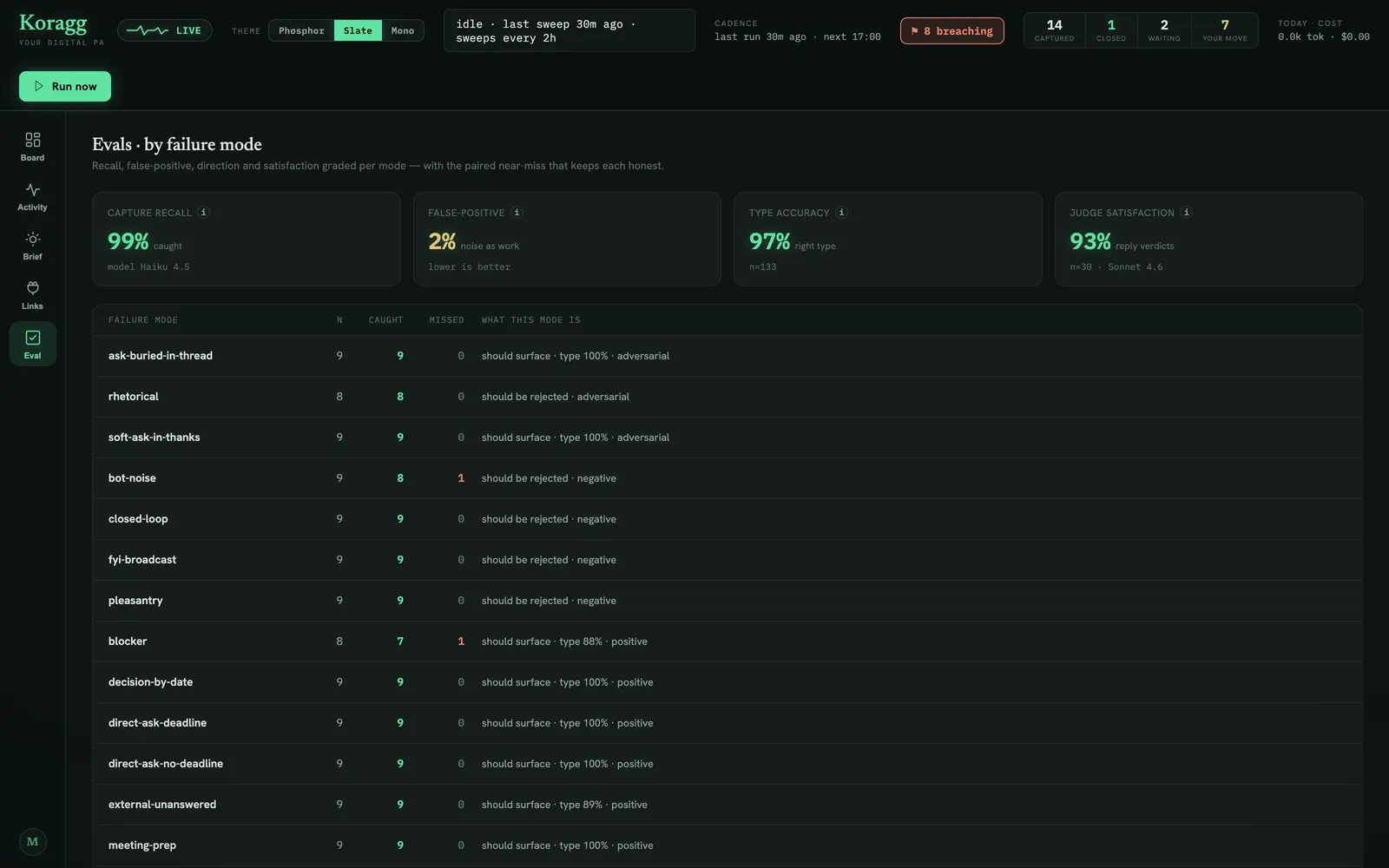
Score by failure mode, never as one number. The evaluation harness grades the two consequential model decisions over 133 labelled cases and reports 15 failure modes separately across adversarial, negative and positive categories. The adversarial set covers the cases that matter most, including a request buried in a thread, a rhetorical question that only looks like an ask, and a real ask hidden inside a thank-you message. On the graded run this holds 99 percent capture recall, a 2 percent false positive rate and 97 percent type accuracy. Because run-to-run model variance is real, the regression gate is a per-mode comparison against a committed baseline rather than the headline figures.
Persist properly and write nothing. The ledger is SQLite, keyed so that re-ingesting the same message is idempotent, and it survives restarts. Every outbound action stays a draft for review and is never sent automatically.
What the prototype does
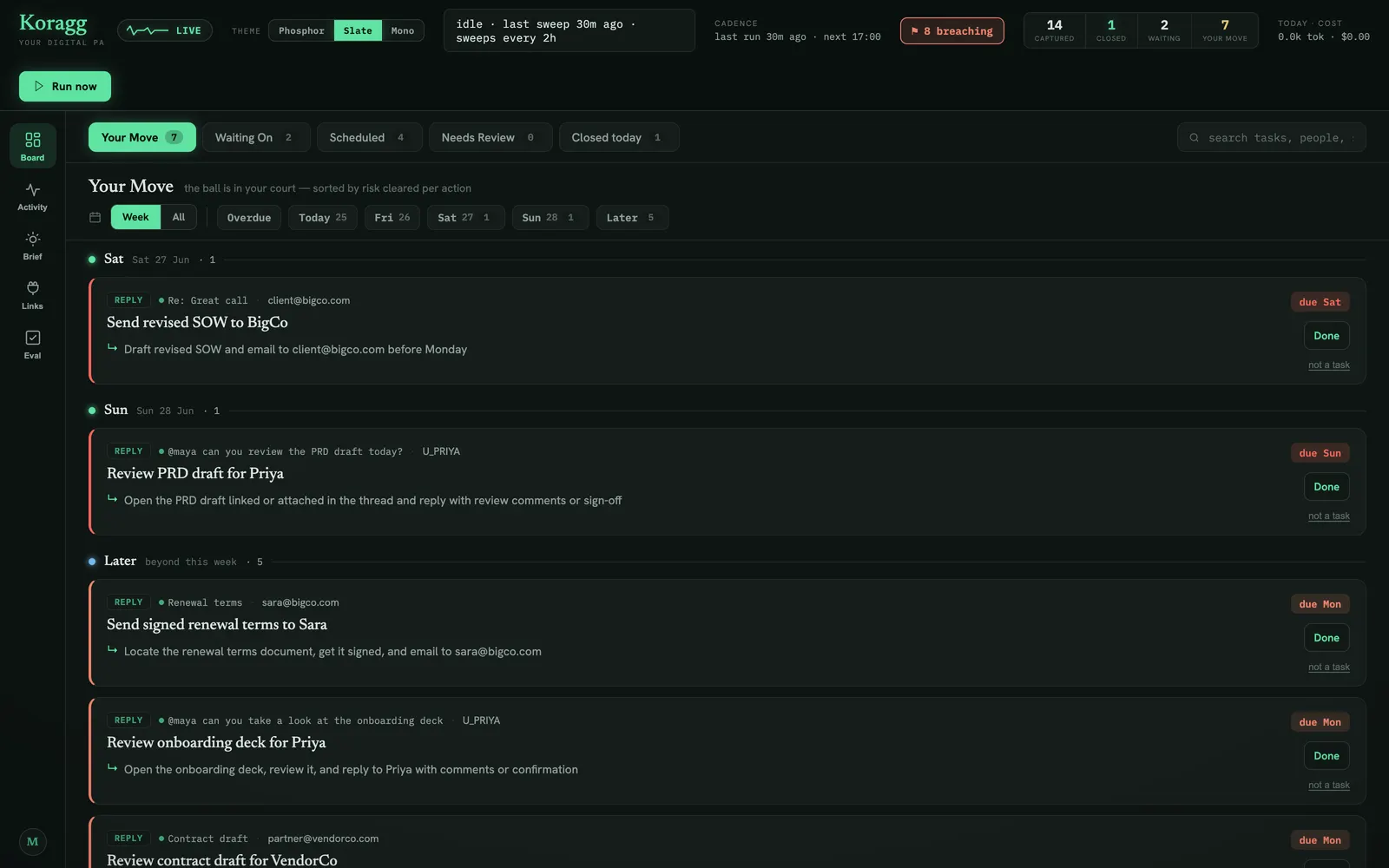
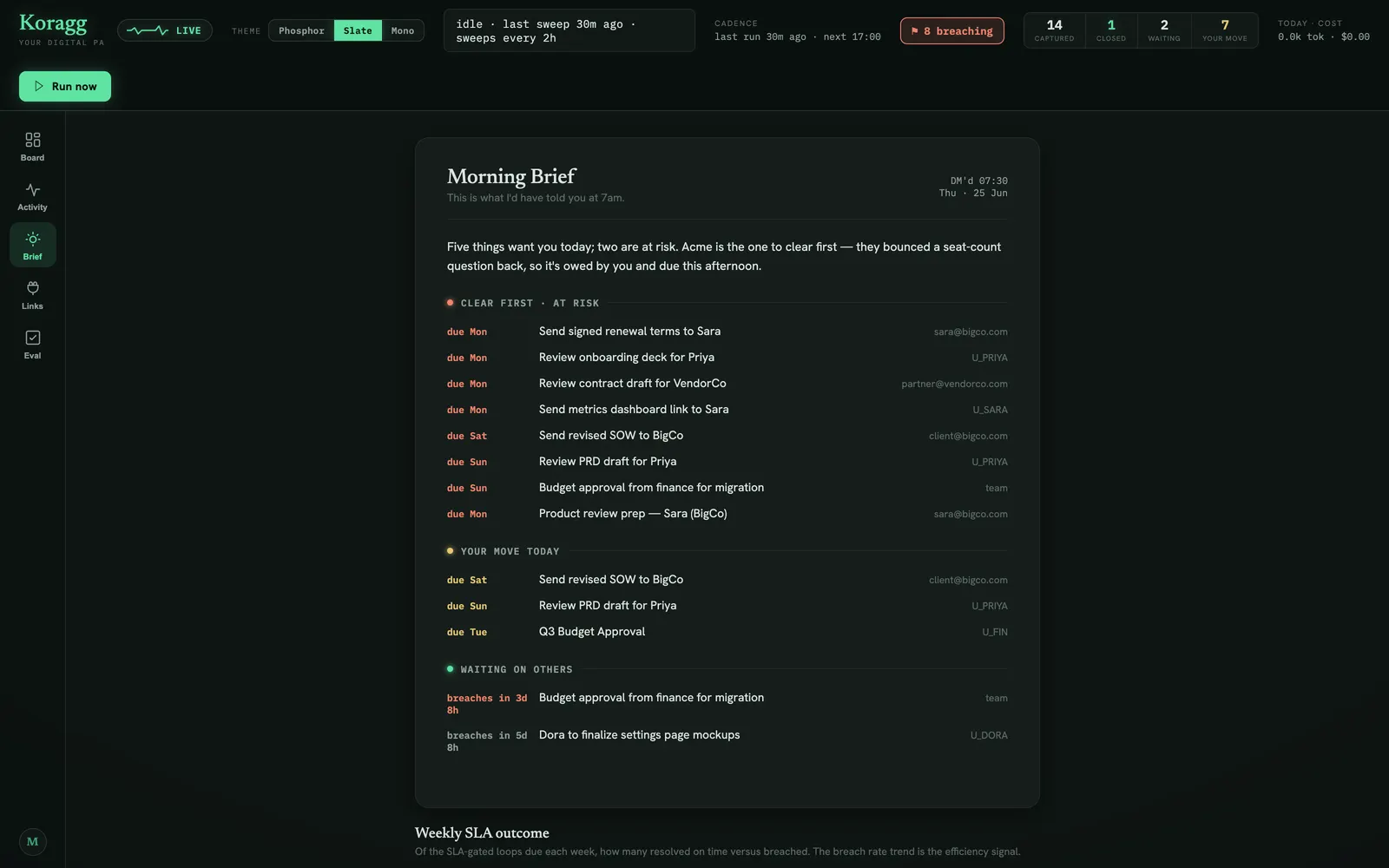
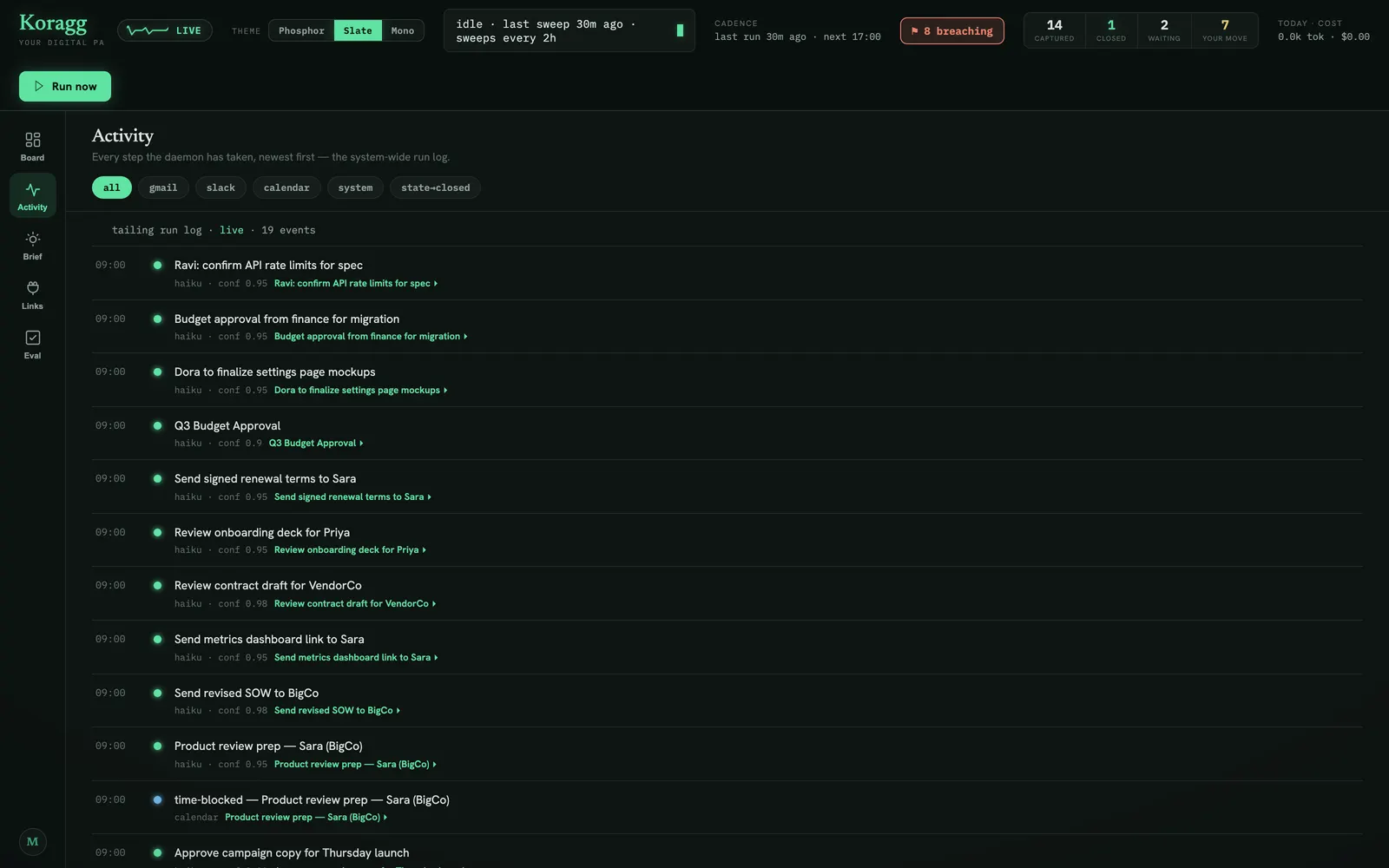
It runs a three-day synthetic world end to end: a cold start that builds the ledger from zero, a sweep that replays later messages and ages items toward breach, a scheduler that time-blocks owed work into open hours, a prioritised morning brief, the evaluation matrix, and a read-only dashboard with a per-item trace showing the source message alongside the agent’s step-by-step decisions. The same code path runs against real Slack and Gmail with credentials supplied, and in that mode all data stays on the local machine.
Reflection & tradeoffs
- Reporting one aggregate score would have hidden the failures worth fixing. Recall of 99 percent looks settled until the breakdown shows which single mode is carrying the misses. Splitting the report by mode is what made the evaluation useful for deciding what to work on.
- The timer is the product. Classification is the part that looks like the interesting problem, but the durable value comes from the lifecycle that keeps an item alive and correctly assigned until something actually satisfies it.
- Read-only is a deliberate limit, not an unfinished edge. An agent that sends on your behalf has to be right about intent every time, and nothing in the evaluation yet justifies that.
- What I would build next: widen the labelled set beyond the synthetic world, since fixtures written by the same person who wrote the classifier will always flatter it, and grade the planner’s definition of done more strictly, because every close decision downstream depends on how well that was written.
Screens