Case 07 / 10
CloseSure: substantiating a balance sheet instead of asserting it
A month-end close tool that computes what supports each balance from data the business already has, sends only the exceptions to people, and refuses to let a sign-off hide a remaining exposure.
Context
In a monthly financial close, the statutory filings have deadlines and therefore get done. Balance substantiation, which is the work of proving what actually supports each number on the balance sheet, has no deadline of its own. It accumulates quietly through the year and then has to be reconstructed under pressure at audit. I built CloseSure to work through what a tool for the Indian mid-market would look like if it treated substantiation as the primary job rather than a reporting by-product.
The problem
The segment I scoped for is roughly ₹80 crore to ₹800 crore in revenue with a finance team of three to fifteen people. These teams have outgrown spreadsheets for substantiation but cannot justify enterprise close software, so the work is done by hand every month and the evidence lives in someone’s inbox.
There is also a design trap in this category. It is easy to build a tool where signing off makes a problem disappear from the screen. That produces a clean-looking close and an unchanged underlying exposure, which is the exact failure the product should exist to prevent.
Approach
Compute the support instead of collecting it. The system imports the trial balance along with data the business already generates: bank statements, the cash ledger, the purchase register, and the government tax return in the portal’s own format. From those it derives what supports each balance, rather than asking an accountant to assemble the evidence by hand.
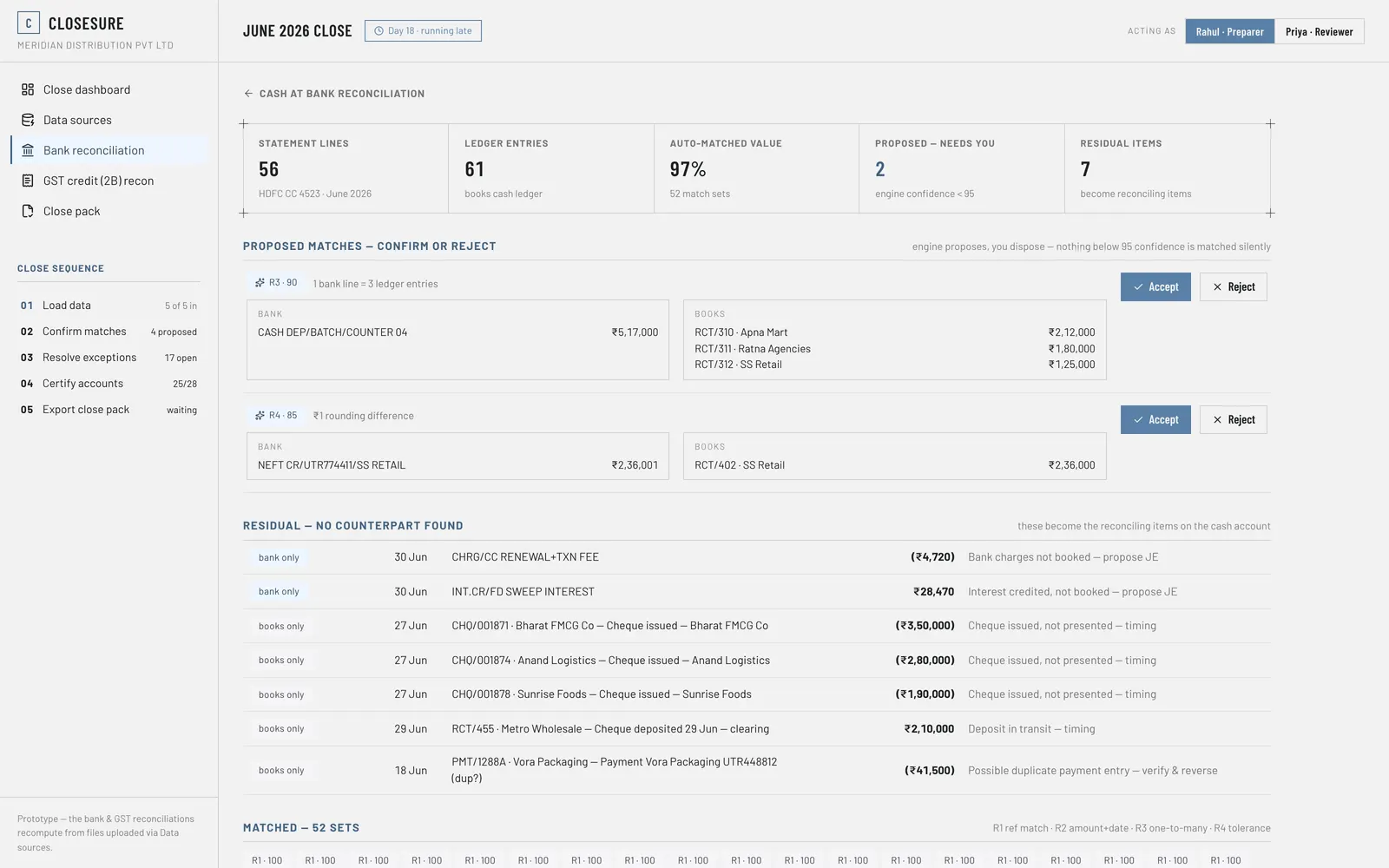
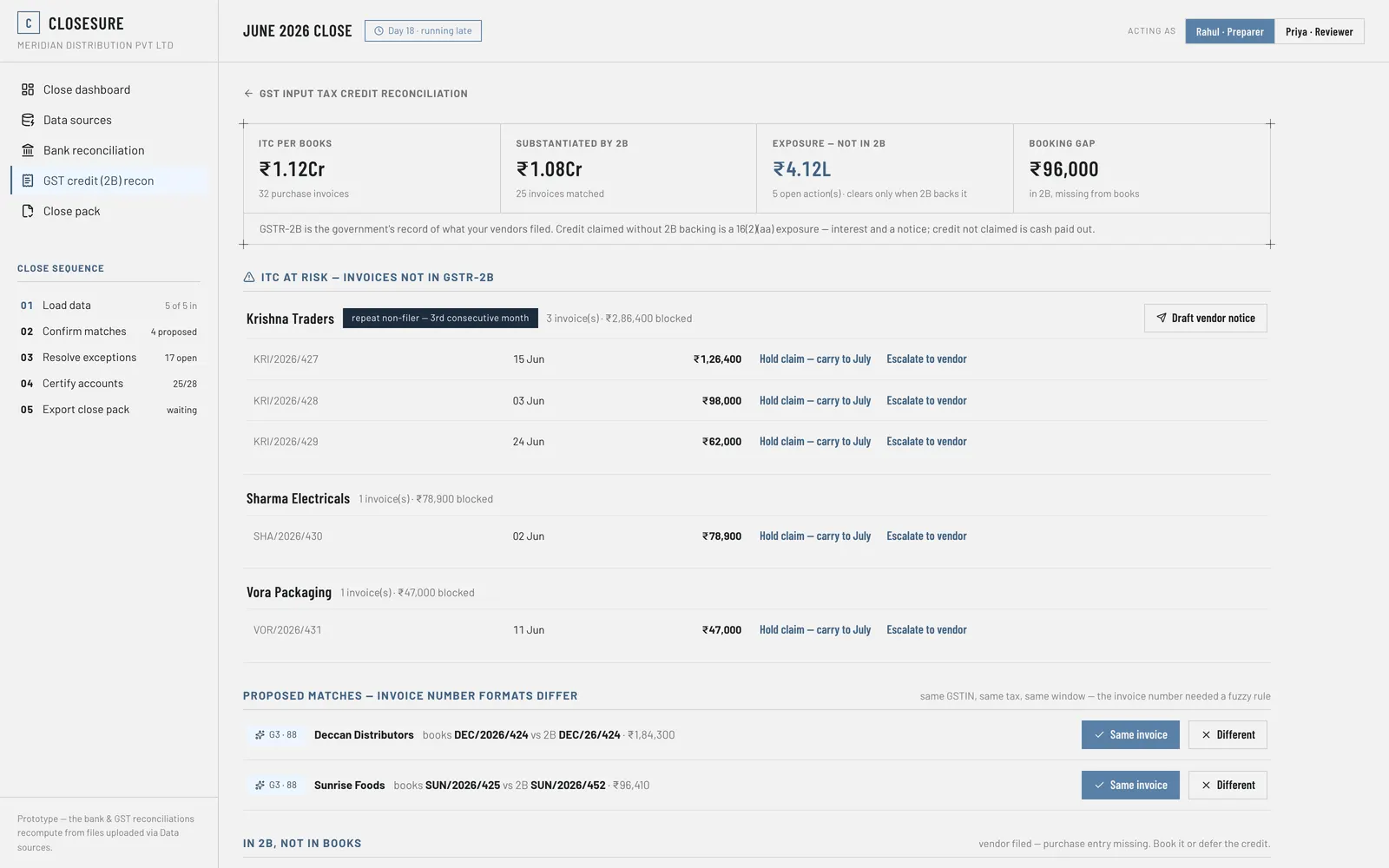
Two matching engines, and a stated confidence line for silence. Bank reconciliation and input tax credit reconciliation both resolve match sets automatically only where a near-deterministic key exists, such as the bank’s own transaction reference. Anything below that line is proposed to a person rather than matched silently. The reasoning is asymmetric: a wrong silent match corrodes trust in every other number on the screen, while a wrong proposal costs one click.
Wrap it in certification discipline. Accounts move through prepare, review and certify. Every engine action and human decision lands in an append-only activity log, evidence is required above a value threshold before an account can be submitted, and the same identity cannot both prepare and certify an account.
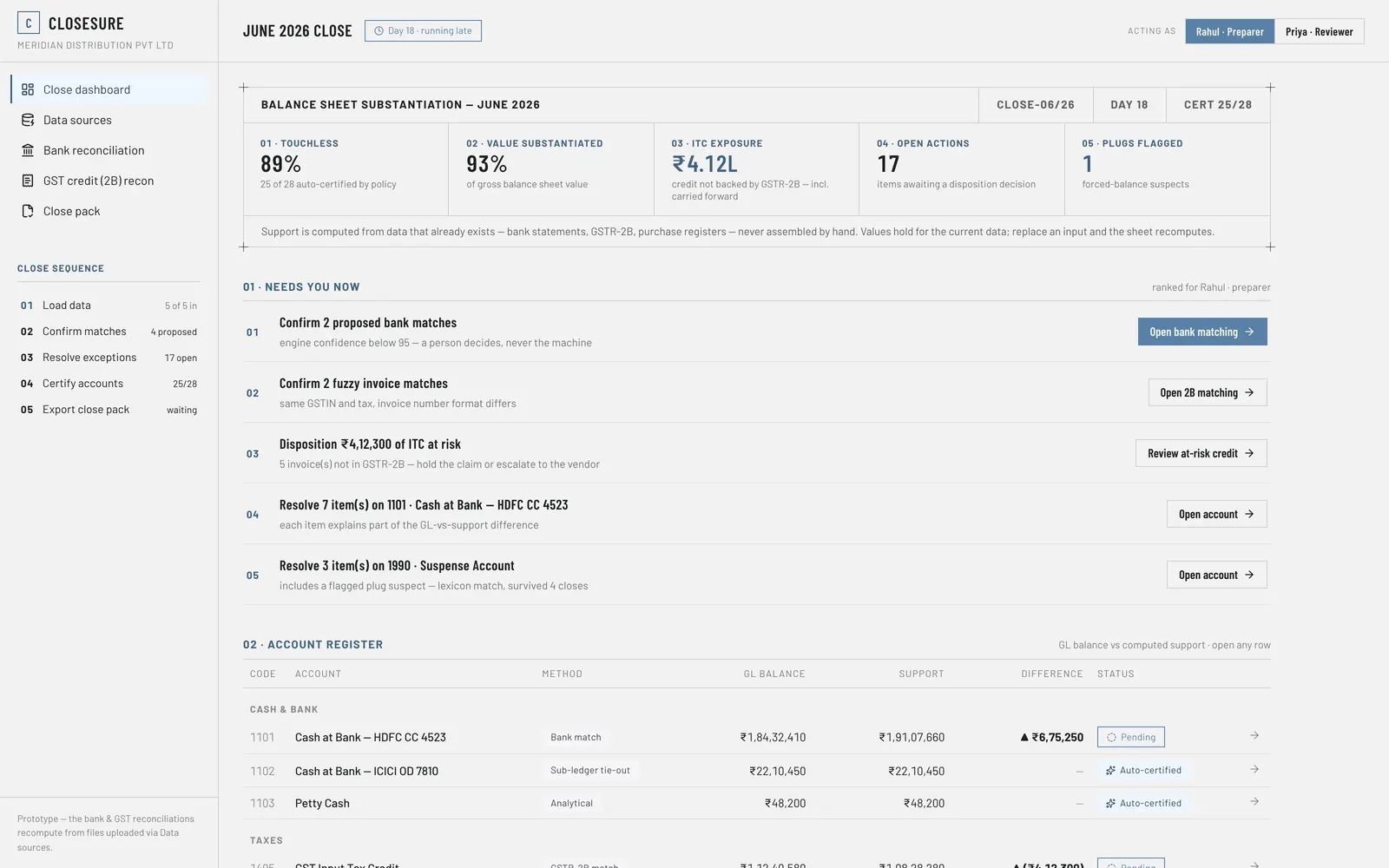
Track two numbers and never merge them. Open actions measure workflow and fall as decisions get made. Economic exposure measures money and falls only when the supporting data confirms it. Dispositioning every at-risk invoice takes the open action count to zero while the exposure stays visible on the dashboard, because a workflow decision does not put cash in the bank. Certification records decisions and does not conceal exposure.
Look for the entries that are quietly wrong. A suspense entry described as being booked to balance and still open four closes later is flagged as a forced balance in June, rather than found by an auditor in September.
Recompute from the inputs, every time. Replacing an input file recomputes the matches, the vendor flags, the exposure figure and every dashboard state derived from them. This was a deliberate constraint on myself, because it is the difference between a prototype that demonstrates a system and one that only demonstrates a set of screens.
What the prototype does
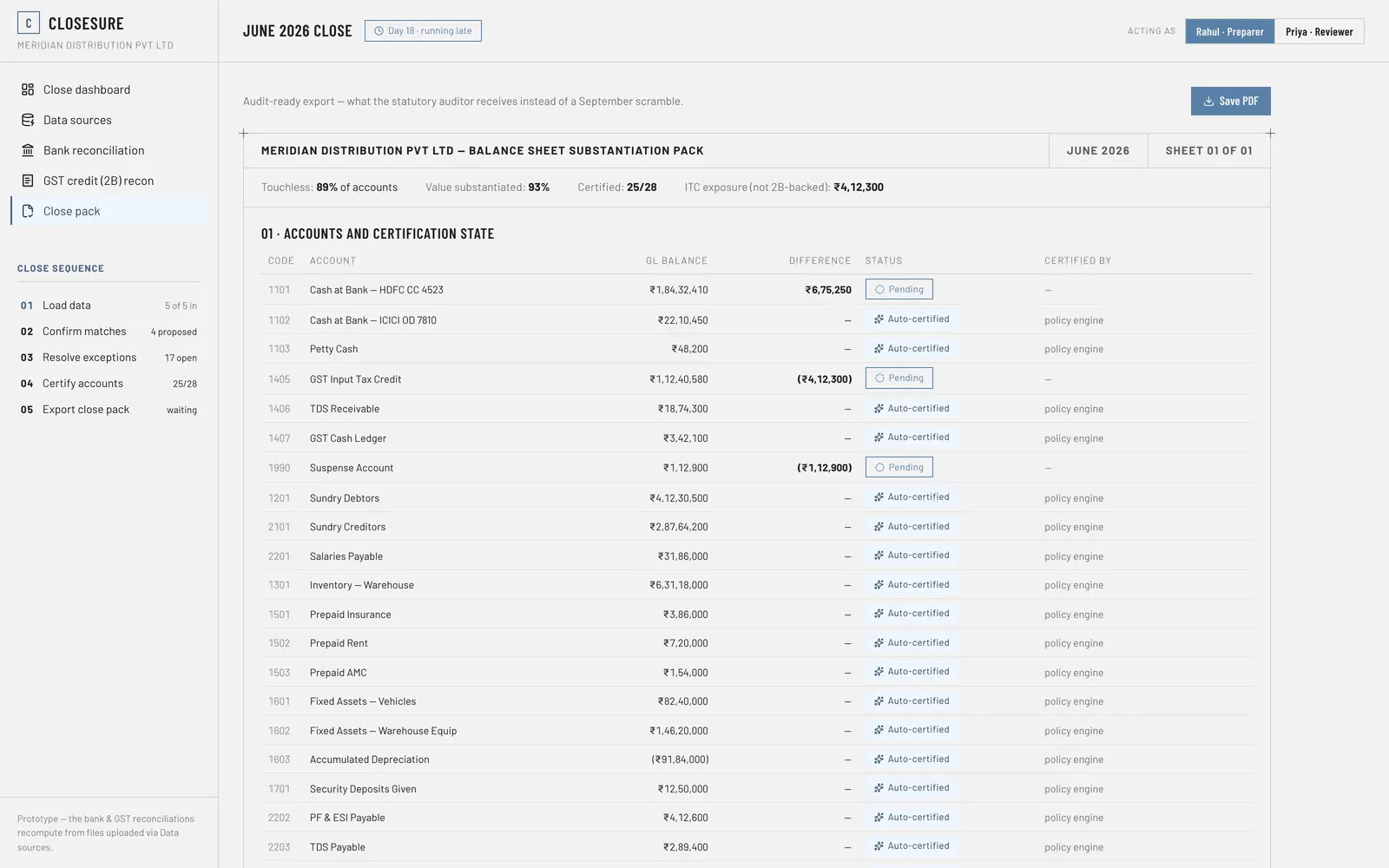
It carries a 28-account close from data import to a certified close pack. Twenty-five accounts auto-certify under policy with the governing rule logged against each one, and the three that carry real risk are routed to people: cash, input tax credit and suspense. Each of those opens into a workspace that decomposes the difference into causes, gives every item an age measured in closes survived, and requires a disposition. The close pack exports an audit-ready statement showing that every account was either automatically supported or reviewed, every exception was dispositioned, every sign-off is attributable, and any credit still awaiting vendor filings is carried forward in writing.
Reflection & tradeoffs
- The most useful decision was refusing to let certification zero the exposure. It makes the demo look worse and the product more honest, and it is the single choice that most shaped the rest of the design.
- A single north-star metric would have been gameable here. Days to close falls if you simply assert balances, and credit recovered describes one customer’s leak rather than the general problem. I paired value substantiated with certification integrity, because loosening a threshold raises the first and lowers the second, so neither number means anything alone.
- Thresholds are configuration, and controls are not. The confidence line, the rupee tolerance and the age at which an item is treated as stale are all per-customer parameters with defensible defaults. Changing them changes numbers, and it should never change the shape of the control.
- What the demo does not prove: the touchless rate here comes from data seeded to exercise every rule, so it is higher than a real first month would be. The claim I would defend is narrower, which is that the exposure in this dataset is traceable to the rupee and recomputes when the inputs change.
Screens