Case 08 / 10
AI Dietician Scribe: a consult-to-plan pipeline with a safety gate
Five stages from an ambient consultation to a printable Indian meal plan, where every clinical number comes from a deterministic calculator and no unresolved field can pass through.
Context
A solo dietician in India runs a consultation, and then spends the evening turning handwritten notes into a structured record, a set of energy and macronutrient targets, and a weekly meal chart. That path is repetitive and highly structured, which makes it an obvious candidate for automation. It is also clinical, which makes naive automation dangerous. I built this to work out what it takes to automate the path without letting a language model anywhere near the numbers that matter.
The problem
The obvious build is a single model that listens to the consultation and writes a plan. It fails in ways that are difficult to notice. It invents a nutrition value for a food. It records an allergy with the polarity reversed, so “not allergic to nuts” becomes an allergy. It produces an energy target below a safe floor. It applies a weight-loss deficit to a patient who is pregnant. Each of these outputs is fluent, plausible and clinically consequential, and none of them looks like an error on the screen.
Approach
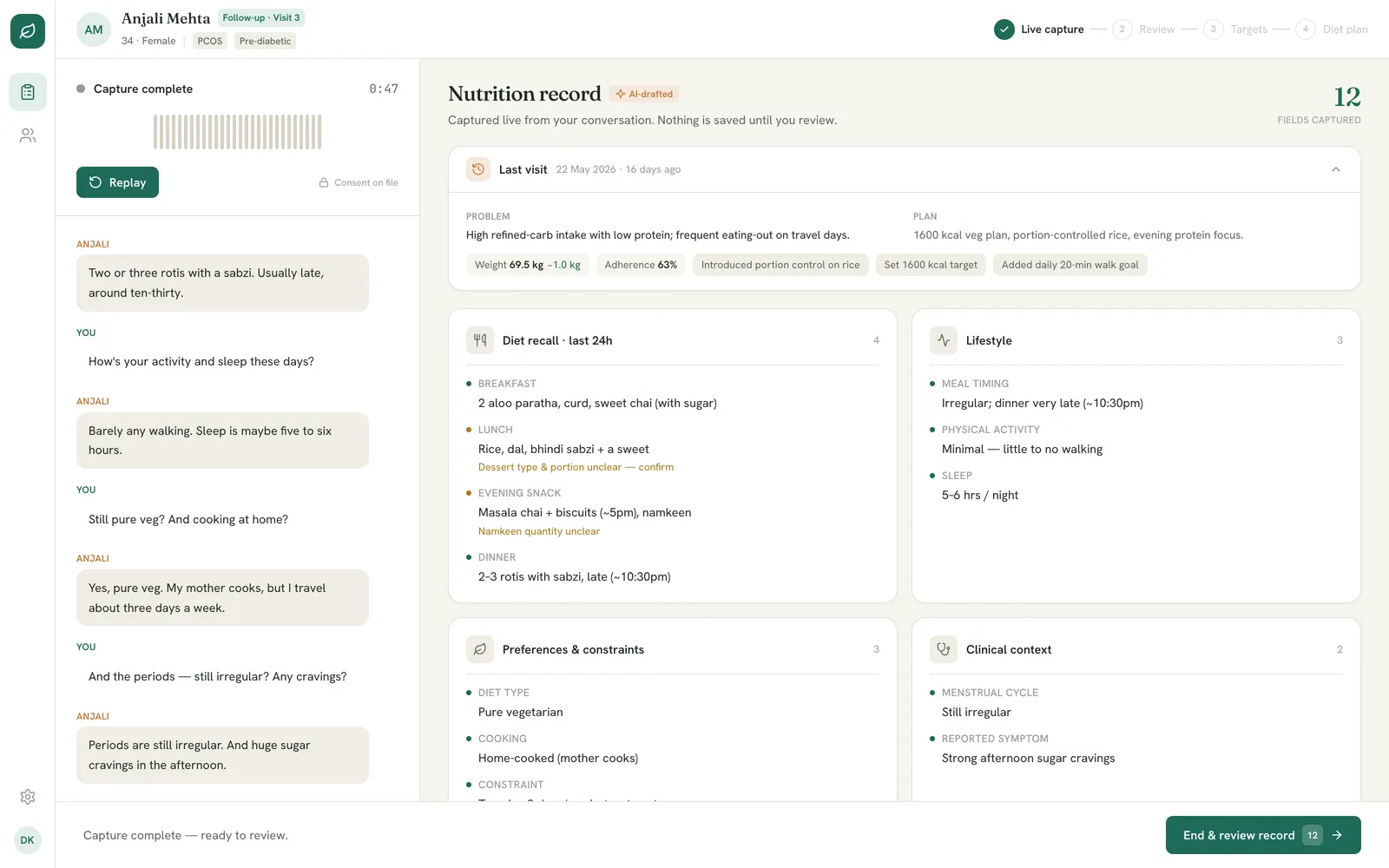
Split the work into five stages with separate outputs. Capture produces a diarised transcript. Structure produces a nutrition record with per-field confidence. Reason produces energy and macronutrient targets plus a nutrition diagnosis. Generate produces a grounded meal plan. Remember carries the record forward to the next visit. Each stage has its own output, its own failure surface and its own score, so a regression can be attributed to a specific step instead of to the system as a whole.
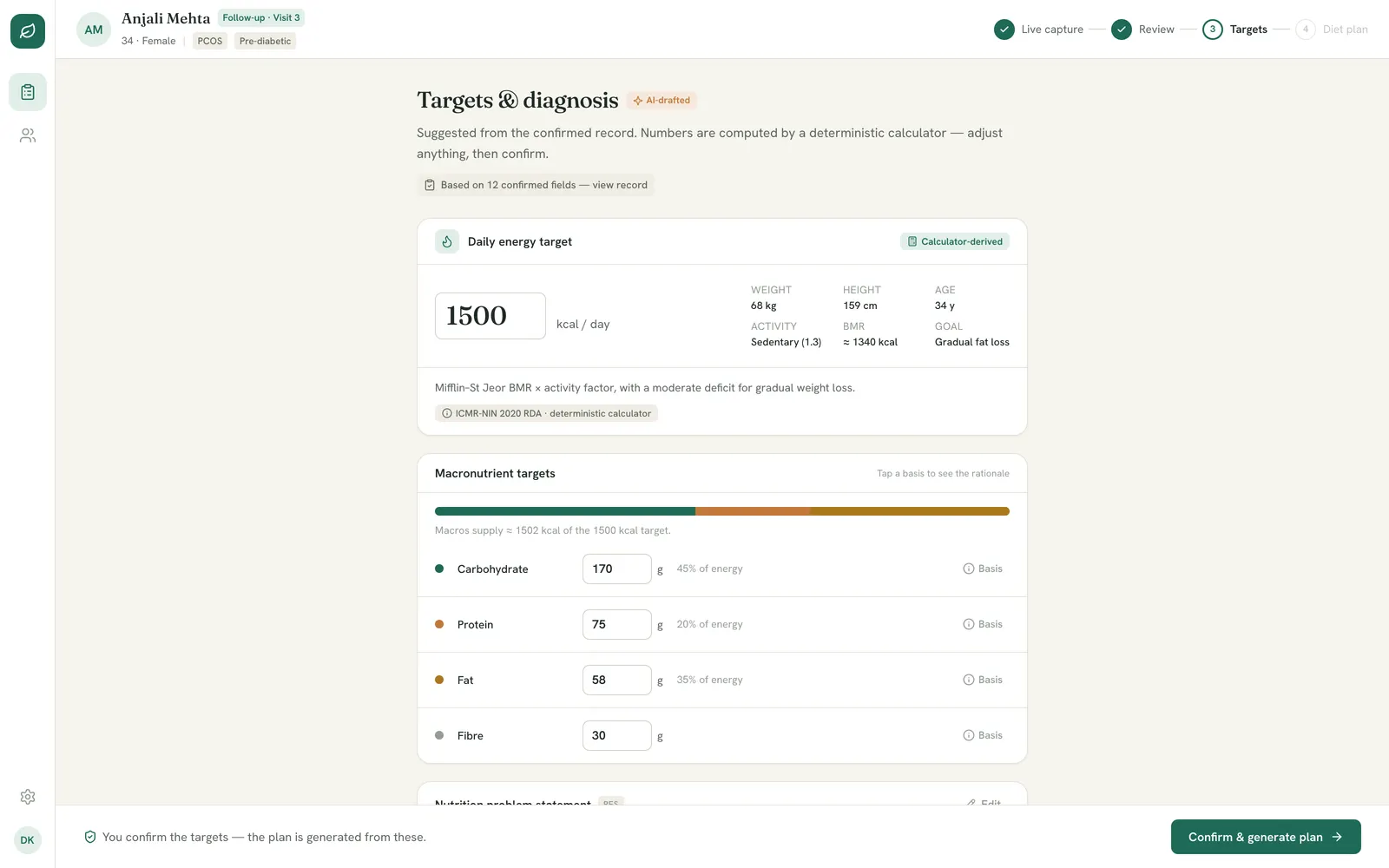
Take the numbers away from the model. The energy target is computed by a deterministic calculator using the Mifflin-St Jeor equation and an activity factor, with a condition-appropriate macronutrient split. The model writes the rationale and the problem statement around those numbers, and every number displayed to the user has to trace back to a calculator field. A number that appears in model prose without that trace is treated as a provenance violation rather than a wording issue.
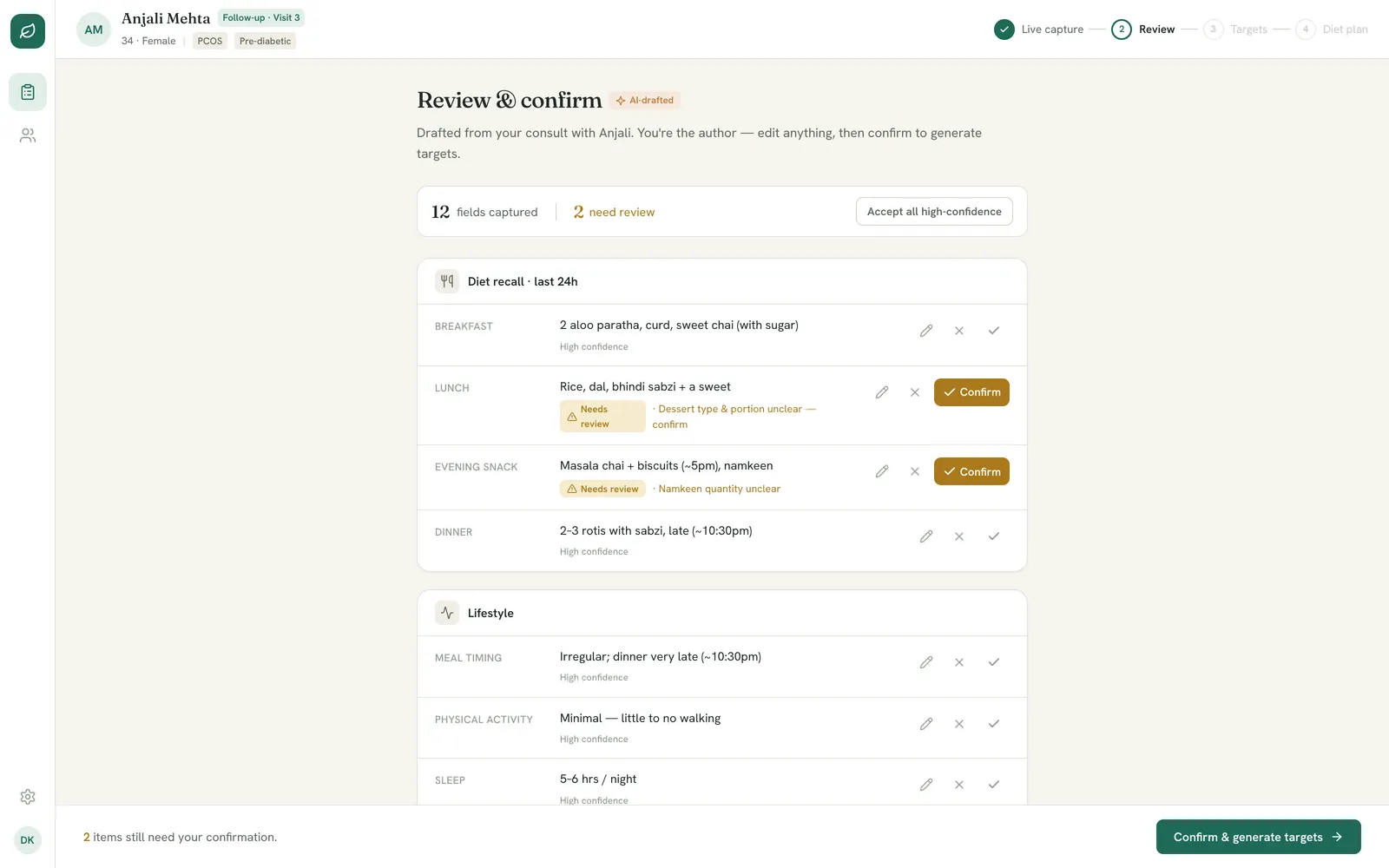
Gate the transition between stages. Extraction marks fields it is unsure about, and the confirm action that generates targets stays blocked until every flagged field has been accepted, edited or rejected. The pipeline cannot carry an unresolved field into a calculation.
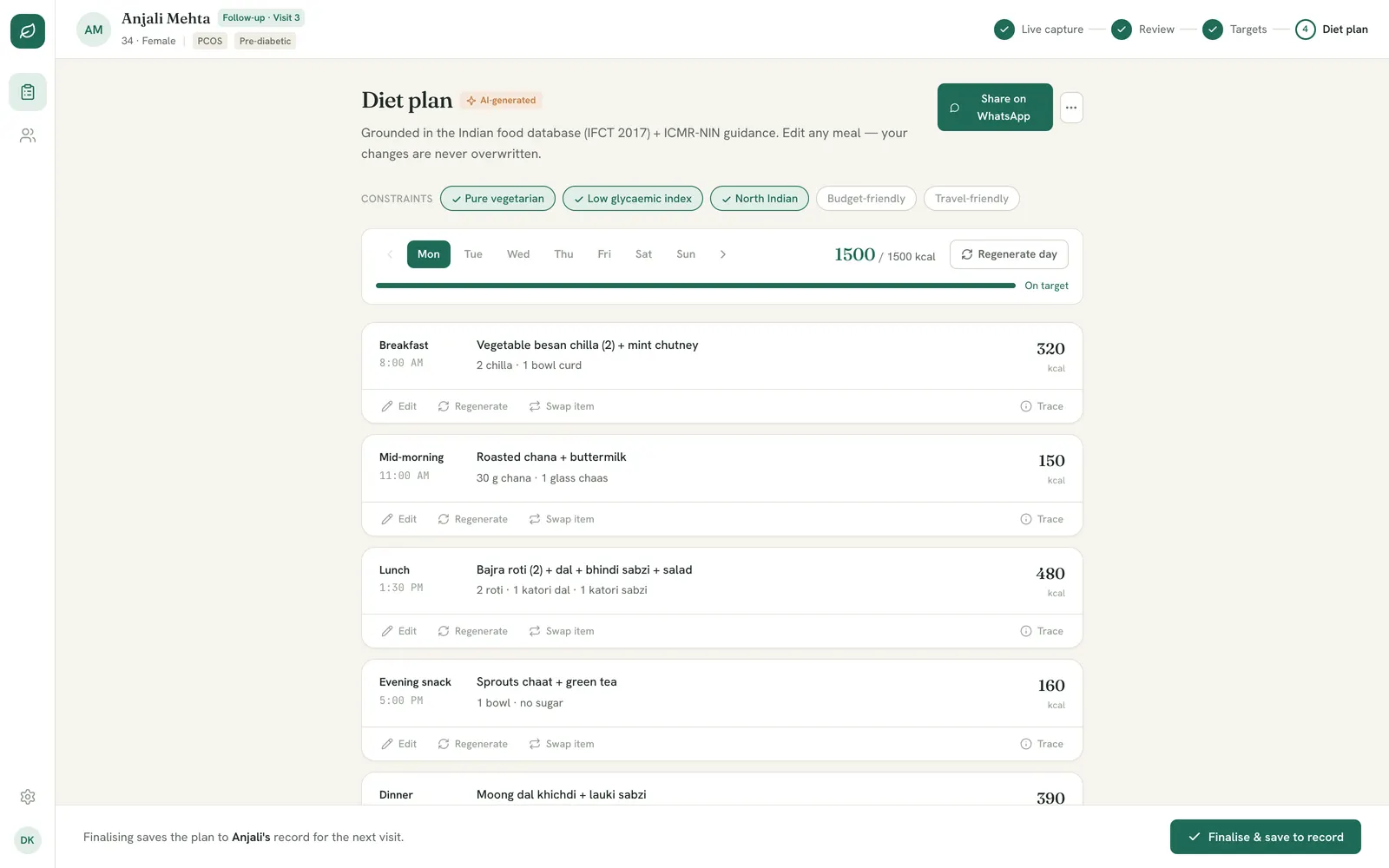
Ground the generated content. Plan items resolve to entries in the Indian food composition tables, guideline claims cite the national nutrition recommendations, and each item carries its source so the dietician can check it. Regeneration is scoped, so asking for a new day does not overwrite edits already made.
Keep the human structurally in the loop. Every generated output is labelled as AI-drafted or AI-generated and remains editable, transcript lines can be redacted during capture rather than after, and the plan is finalised by the dietician before it reaches a patient.
Write the evaluation rubric before the backend. The rubric grades 37 criteria across the five stages plus a cross-cutting block, against eight gold-labelled Indian consultation cases covering conditions such as gestational diabetes, chronic kidney disease, thyroid disorders and paediatric underweight. A safety gate is evaluated before any averaging, so a run that fabricates a calculator number, inverts an allergy, misses a special-population override or leaks data across patients fails outright regardless of how high its overall score is.
What the prototype does
The five-stage flow runs end to end with realistic data and real state carried across stages, so redactions, edits, confirmations and the finalised plan all flow through to the patient timeline. The interface is complete and the evaluation design is written. The backend architecture is specified in detail, including managed speech recognition for Indian languages behind a provider interface, incremental extraction, deterministic calculators exposed as tools, and retrieval over the food composition database, but it is not yet built.
Reflection & tradeoffs
- Writing the rubric first changed the design. Working out how a stage would be graded surfaced the failure modes that mattered, and several product decisions, including the confirm gate and the number provenance rule, exist because the rubric demanded something checkable.
- Averaging is the wrong instinct for safety. A high overall score can sit comfortably on top of an inverted allergy. Making the safety criteria a hard gate evaluated before any aggregation is what stops a good average from hiding a dangerous run.
- Confidence flags create their own risk. Flagging too much produces alert fatigue, and the dietician starts accepting everything without reading it. The rubric weights failing to flag a genuinely ambiguous clinical field more heavily than over-flagging a clear one, but that balance is a real tradeoff and needs to be measured with actual users.
- What I would build next: the capture stage, because it is both the hardest and the most consequential. Errors in transcribing a weight, a dose or a food quantity propagate silently into every calculation downstream, which is why numeric accuracy is gated harder than word accuracy in the rubric.
Screens